Water Pressure Diagnosis checks residential supply readings, fixtures, and pressure equipment. Testing and access affect the scope; call for a job-specific estimate.
Water Pressure Surges Without Warning: Regulator or Pressure Tank?
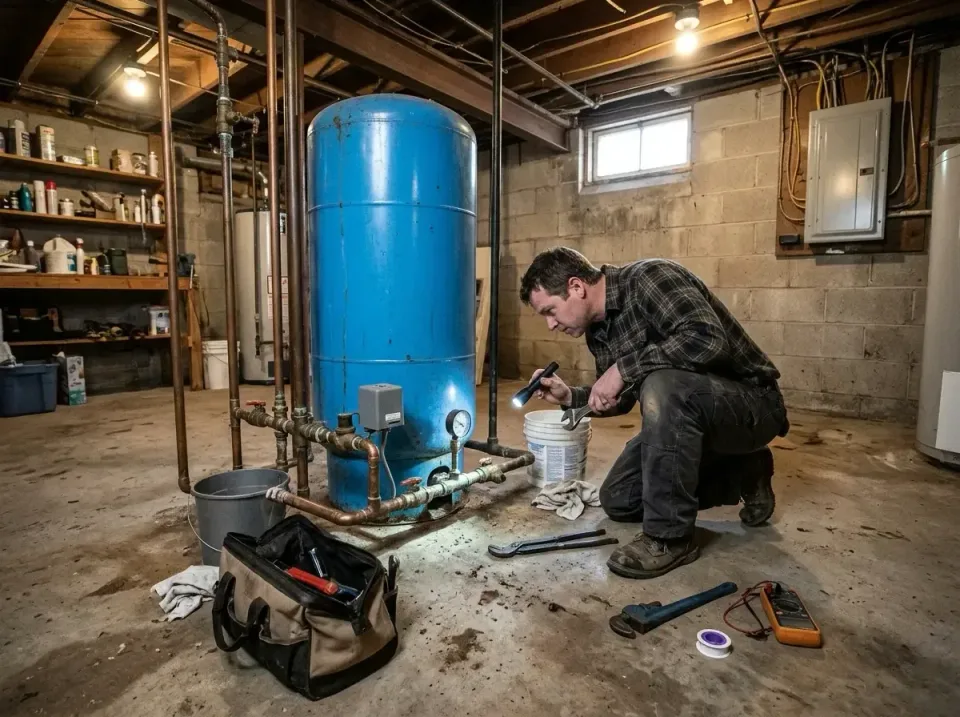
Why Does Water Pressure Surge Without Warning?
A regulator or pressure tank can cause sudden pressure swings, but the right answer depends on whether the home uses city water or a private well. If a shower pulses while the kitchen tap runs, note whether the surge affects every fixture or just one area. That difference helps narrow the fault.
A well pressure tank uses a bladder or diaphragm to separate water from compressed air; when that barrier fails, pressure can rise and fall sharply as the pump cycles. On city water, an obstructed or failing regulator can allow incoming pressure to fluctuate.
Keep the area around the regulator unobstructed so it can be inspected and serviced without extra access work. Seasonal irrigation can also contribute to neighborhood pressure fluctuations. We can compare readings and system behavior before recommending a repair.
What Do Pressure Surges Reveal About a Well Tank?
If a well pump starts and stops repeatedly as taps run, the pressure tank may not be buffering demand correctly. A bladder or diaphragm failure can leave too little usable stored water, making the pump respond to small changes in household use. Listen for rapid cycling, but do not open electrical controls or adjust the switch yourself.
Winter power outages can interrupt pressure tanks and pumps, so a surge that starts after an outage may involve power restoration or pump operation, not automatically a failed regulator. We check the pressure pattern alongside pump behavior before identifying the likely cause. The Old Idaho Penitentiary is a recognizable Boise landmark; on properties around the region, exposed outdoor lines also face stress from freeze-thaw cycles, which can complicate pressure symptoms.
Can a Regulator Cause Surges in a City-Water Home?
Yes, a worn or sticking pressure regulator can let incoming pressure vary instead of keeping the home’s supply steady. A useful clue is whether several fixtures change together. If only one faucet pulses, the issue may be local to that fixture rather than the whole supply.
For Boise municipal water, we compare pressure behavior at suitable test points and inspect the regulator and nearby piping. We also look for signs of a leak before recommending a valve replacement; water main leak detection matters when pressure changes coincide with unexplained wet ground or a persistent sound near the service line. Around the Boise River Greenbelt, local homes still differ in plumbing layout and access, so diagnosis starts at the property rather than with assumptions.
When Is a Pressure Surge a Reason to Call a Pro?
A single brief change may be worth observing; repeated surges, loud pipe knocks, leaks, or rapid well-pump cycling call for professional diagnosis. Water hammer can stress joints and fixtures over time, and guessing at a regulator adjustment may worsen the problem. Leave electrical pump controls and pressure-system adjustments to a qualified plumber.
Private well water systems need the pump, tank, switch, and connected piping considered together. We inspect how pressure changes as water runs, then explain whether repair or a further test makes sense.
If a line is exposed outdoors, freeze-thaw cycles can stress it and make a developing leak harder to dismiss. Boise and the Snake River Plain have semi-arid conditions; an unexplained change in outdoor moisture near a line deserves attention rather than prolonged observation.
How Do We Separate a Tank Fault from a Regulator Fault?
We look at the water source, when the surge occurs, and whether the symptom affects one fixture or the whole home. A well system’s pressure change may track pump starts; a city-water problem may be more consistent across fixtures. Neither clue proves the cause by itself.
Scheduled pump and regulator maintenance can reveal worn components before irregular operation becomes a bigger disruption. Whole-home pressure balancing is also worth considering when different fixtures behave differently, but it should follow diagnosis, not replace it.
Our crew traces the symptom before recommending parts. For more context on related symptoms, read what repeated well pump cycling says about the pressure switch or why water pressure falls when multiple taps run.
Which Repair Fits a Pressure Surge?
If pressure swings affect several taps, the right repair depends first on whether the home uses municipal water, a well, or a booster system. The history of pumping helps explain today’s equipment, but it does not diagnose a home by itself.
| Option | Best for | Key detail |
|---|---|---|
| Municipal supply pressure repair | Surges across several fixtures on city water | Compare pressure with fixtures closed and while water runs. |
| Pressure regulator repair | Incoming pressure that varies through the home | The regulator controls incoming pressure; adjustment should follow testing. |
| Well tank and switch repair | Pressure changes that track pump operation | The tank stores well water under pressure; the switch starts and stops the pump. |
| Booster pump repair | Supply that needs added pressure | A booster raises pressure when supply is insufficient; motor operation and demand matter. |
Denis Papin described an early centrifugal pump in 1689; that history is no substitute for checking the equipment installed today. Goulds began in 1848, illustrating how long pump systems have been part of water service.
Cold-water distribution and hot-water distribution should be checked separately when symptoms affect only one side. Boise Airport is a local reference point, while cold winters increase freeze risk for exposed plumbing around Idaho.
Prepare the Shutoff and Pressure Checks
-
Record the symptom: Note which fixtures surge and whether the change begins when another tap or appliance runs.
-
Confirm the water source: Tell the technician whether the home uses city water or a private well; this determines which pressure equipment needs inspection.
-
Find the main shutoff: Locate it before the appointment and clear access to the valve, so service does not stall while household water needs to be isolated.
-
Make the work area accessible: Move stored items away from the regulator, pump, or tank, and clear space near the water heater if nearby piping needs inspection.
-
Leave adjustments to the technician: Careful regulator adjustment requires a measured diagnosis; changing settings by guesswork can hide the original fault.
-
Ask about next steps: A booster pump sizing guide for homes should account for actual household demand, not just a single fixture’s complaint. Building water-system troubleshooting helps distinguish equipment faults from piping issues; Denis Papin’s early pump work is history, not a repair instruction.
Heavy mountain snowfall can delay access to some properties, and the Boise River Greenbelt is a familiar local landmark. Plan access accordingly.
Common Questions About Low Water Pressure Repair in Idaho
Can Water Pressure Surge Without Warning If Only One Bathroom Has Weak Flow?
Yes, a single bathroom with changing flow can point to a local restriction rather than a whole-house regulator or tank fault. Check whether nearby fixtures change at the same time, and mention a clogged faucet aerator during diagnosis because debris there can limit that fixture’s flow.
How Much Does Water Pressure Regulator Repair Cost for Pressure Surges?
Water Pressure Regulator Repair is listed at $150–$500 for parts and labor; a separate pressure diagnosis is $75–$200 based on testing and access. The final quote depends on the regulator condition, replacement parts, and how accessible the plumbing is.
Should I Adjust a Pressure Regulator Myself When Water Pressure Surges?
No, repeated surges should be measured before anyone changes the regulator setting, since the pressure tank, pump, or piping may be involved. Idaho Plumbing Pros can test the system and explain a safe repair path; booster-pump commissioning support is useful when the diagnosis points to newly installed or serviced pump equipment.
Do Idaho Plumbing Permit Rules Apply When Replacing Pressure Equipment?
They may, depending on the alteration and local requirements, so confirm Idaho plumbing permit rules with the local authority before regulated work. The Idaho Plumbing Code edition adopted for the project should also be verified, and Boise plumbing permits may apply to regulated alterations in Boise.
Could High Elevation or an Aerator Explain Pressure Surges in Idaho?
Yes, a faucet aerator can restrict one fixture’s flow, while high-elevation communities face longer freezing seasons that can affect exposed plumbing and access. Those clues do not prove the source of a whole-home surge, so compare the symptom across fixtures and arrange diagnosis if it keeps returning.
Ready to Trace a Pressure Surge in Idaho?
If pressure jumps throughout the home, or a well pump keeps cycling, arrange a diagnosis instead of adjusting equipment by guesswork. A hose-thread gauge can record supply pressure; on a well, the tank precharge should only be checked with pump power off. For context, common well switch settings include 30/50 psi, though systems differ.
Summer heat can raise irrigation demand and water use, while well water levels may vary during prolonged dry periods, so note whether the pattern changes seasonally. Bogus Basin is a familiar Idaho landmark, but pressure diagnosis still depends on the equipment at your property.
Idaho Plumbing Pros can inspect the system and explain repair options. Request Water Pressure Diagnosis or call (877) 773-0781 to discuss what you are seeing.
Whole-house pressure loss service traces weak flow across a home and checks accessible supply piping. Scope and access shape the repair quote.
Low Faucet Pressure Repair checks faucet flow and accessible fixture parts; typical repair costs depend on the faucet model, replacement parts, and access.
Weak hot water pressure service for homes with restricted hot-side flow; repair scope and cost depend on parts, pipe access, and the source of the restriction.
We repair residential well pump pressure problems, checking pump operation and pressure controls; typical repairs run $200–$900 depending on pump condition and parts.
We repair residential booster pumps, checking pump condition and parts; jobs typically run $200–$900, depending on the pump. We serve homes near Downtown Moscow, Downtown Sandpoint, and Lake Coeur d'Alene.
We trace weak cold-water flow for homeowners, checking fixture connections and accessible supply piping; a diagnostic visit typically runs $75–$200, depending on testing and access.
We inspect and repair residential pressure tanks, including accessible well-system connections; typical repairs run $250–$900, depending on tank condition and access.
We trace abrupt pressure drops and repair accessible pipe or system failures; localized leak work commonly runs $150–$800, depending on pipe material and access.
We repair residential pressure-reducing valves, including accessible brass assemblies; regulator work typically runs $150–$500, depending on parts and labor.
Corroded pipe pressure repair addresses rust-thinned or narrowed residential piping, with scope and access shaping typical $300–$2,000 jobs.
Low Shower Pressure Repair checks shower valves and supply flow; typical repairs run $150–$500, depending on parts and access.
We repair well pressure switches for homeowners, checking switch contacts and wiring access; typical replacement runs $150–$400, depending on parts and access.
We repair water softeners restricting household flow, checking valves, resin tanks, and connections; access and component condition shape the scope for Idaho homes.
We clear accessible clogged water lines for Idaho homes; pipe material and access shape the quote. Boise’s semi-arid setting, the Salmon River region, and Bear Lake State Park mark varied local service conditions.
Filter pressure loss repair covers sediment-loaded cartridges and housings for Idaho homes; typical repairs run $100–$500, driven by filter type and access.
We remove or clean accessible faucet and shower flow restrictors for homeowners and property managers; fixture design and access shape the work and quote.
Grundfos Booster Pump Repair in Idaho: inspect pump operation, repair worn components, and review system fit. Call (877) 773-0781 to discuss scope.
Goulds booster pump repairs cover motor, control, and pump issues; typical repair runs $200–$900, depending on pump condition and parts.
We repair buried main water lines for Idaho homeowners and property managers, including accessible pipe sections; typical repairs run $500–$2,500, depending on excavation access and pipe material.
Cities & Towns
Service Areas in Boise
Select a city to find local low water pressure repair providers we cover in Boise.
Bellevue, ID83313Kimberly, ID83341Post Falls, ID83854Meridian, ID83642Priest River, ID83856Mountain Home, ID83647Filer, ID83328Blackfoot, ID83221Wendell, ID83355Lewiston, ID83501Chubbuck, ID83202Fort Hall, ID83203Nampa, ID83687Sugar City, ID83448Pocatello, ID83209Twin Falls, ID83301Emmett, ID83617Malad City, ID83252Idaho Falls, ID83404Orofino, ID83544Dalton Gardens, ID83815Salmon, ID83467St. Maries, ID83861Caldwell, ID83605
Show all 68 cities
Bonners Ferry, ID83805Rupert, ID83350St. Anthony, ID83445Middleton, ID83644Victor, ID83455Lincoln, ID83401Boise, ID83725Eagle, ID83616Burley, ID83318Rigby, ID83442Ammon, ID83406Rathdrum, ID83858Moscow, ID83844Grangeville, ID83530Preston, ID83263Aberdeen, ID83210Hailey, ID83333Heyburn, ID83336Sandpoint, ID83864Weiser, ID83672Ketchum, ID83340Montpelier, ID83254Coeur d'Alene, ID83815Mountain Home AFB, ID83648Homedale, ID83628Hidden Springs, ID83714
Get a Quote
Get a Low Water Pressure Repair Quote in Boise, ID
Share job details below or call our team directly. Phone: (877) 773-0781