Water Pressure Diagnosis checks residential supply readings, fixtures, and pressure equipment. Testing and access affect the scope; call for a job-specific estimate.
Could a Water Softener Be Causing Low Pressure in Your Idaho Home?
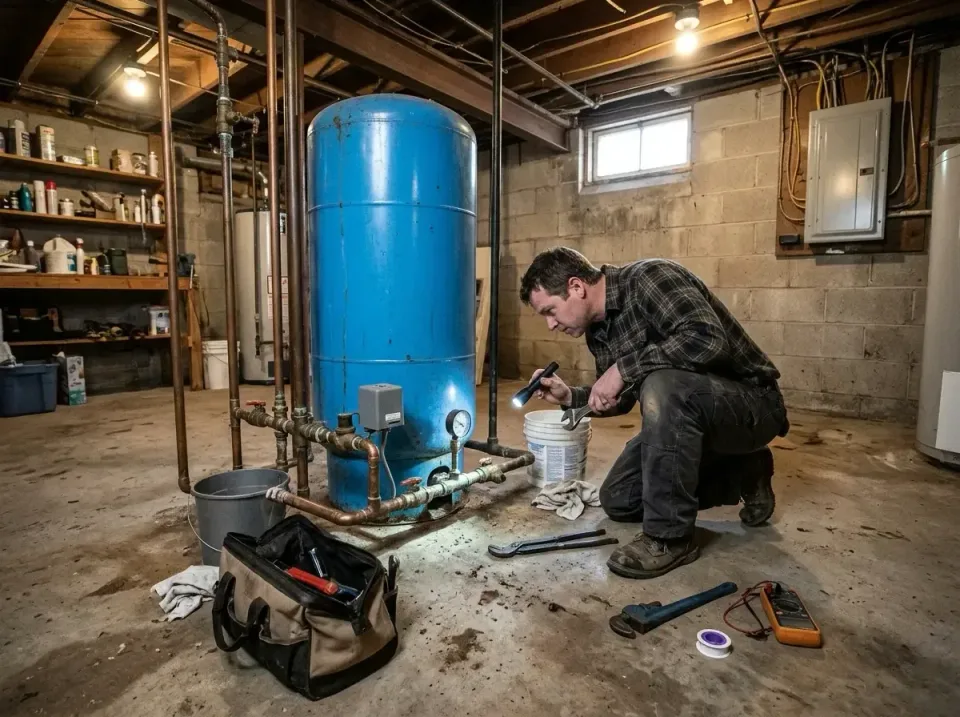
Could Your Softener Be Restricting Water Flow?
A water softener can cause low pressure when a clogged resin bed, dirty control valve, or undersized bypass path restricts flow but it is not the only possible cause. If pressure drops at several fixtures after the softener was installed or serviced, compare flow with the unit in service and bypass; a clear improvement in bypass points toward the softener or its connections.
A weak faucet alone may indicate a fixture problem instead. We trace the system before recommending parts.
Around the Museum of Idaho in Idaho Falls, homes with private equipment can have very different plumbing layouts, so diagnosis starts with the actual supply path. The Idaho National Laboratory area is another reminder that regional water sources and system setups differ.
Northern Idaho generally gets more precipitation than southern Idaho, but rainfall alone does not establish whether a home’s softener is causing a restriction.
When Does a Softener Point to the Pressure Drop?
A softener becomes a stronger suspect when several fixtures lose flow at once and the change began after installation, a service visit, or a long period without maintenance. A technician can compare pressure and flow before and after the softener, then inspect the bypass, inlet screen, control valve, and resin tank for restrictions. The useful clue is not simply whether pressure feels low; it is whether the system’s flow changes when water passes through the unit.
At the Idaho Falls River Walk, a homeowner might notice a whole-house change after returning home, but one weak fixture still calls for a different check. Winter power outages can interrupt pressure tanks and pumps, so a low reading after an outage may not originate in the softener.
The Idaho State Capitol area offers a useful reminder that municipal service and household equipment are separate parts of the supply path. Summer heat increases irrigation demand and water use, which can coincide with pressure complaints without proving the softener is at fault.
For another pattern, see our guide to pressure loss when multiple taps run.
What Do Bypass and Fixture Checks Tell You?
If the softener has a manufacturer-provided bypass, switching it according to the unit’s instructions can help isolate the cause. Do not force a stuck handle or disconnect plumbing under pressure.
If flow improves in bypass, the softener, its valve, or the nearby connections deserve inspection; if it does not, the restriction may be elsewhere. A bypass test is a clue, not proof that the resin needs replacement.
A shower that stays weak while other fixtures work may instead have a clogged showerhead or a branch-line issue. At Idaho State University in Pocatello, as in homes elsewhere, a localized symptom should not lead to replacing a whole-house appliance without checking that fixture first.
Water levels in private wells may vary during prolonged dry periods, which can also affect supply and mimic a softener problem. We compare multiple fixtures and test while water is running, rather than relying on a single static reading.
Our water pressure diagnosis checks help separate equipment restriction from supply-side trouble.
When Should You DIY, and When Call a Plumber?
A homeowner can note which fixtures are weak, check whether the softener display shows an error, and use the unit’s labeled bypass only if the instructions make the steps clear. Avoid opening the control valve, handling electrical components, or changing plumbing connections. A unit that leaks, will not bypass, or causes a sudden whole-house drop needs professional attention.
We have spent more than 11 years serving Idaho, and our crew traces weak flow before proposing a replacement. The Old Idaho Penitentiary is a familiar Boise landmark; older systems in the broader region can include aging pipes that narrow internally, so a softener is not automatically the culprit.
If pressure remains low in bypass, a technician can inspect supply piping, valves, and any pump or tank equipment. If the problem is confirmed at the softener, our water softener pressure repair service focuses on the unit and its connections. We explain what testing found and what repair makes sense for your setup.
Which Pressure Check Fits Your Softener Problem?
The right check depends on whether weak flow is isolated to one fixture, appears throughout the home, or changes when the softener is bypassed. These comparisons help narrow the path; they do not diagnose a specific house by themselves.
Brigham Young University–Idaho in Rexburg is a local point of reference, but the home’s actual water source and equipment determine which check applies. Low summer rainfall can strain private wells, so a softener test should not overlook reduced well supply.
Freeze-thaw cycles can stress outdoor water lines; visible damage or a leak may call for line inspection rather than softener service. Near Bruneau Dunes State Park, dry conditions make it especially useful to distinguish equipment restriction from a supply problem.
| Option | Best for | Key detail |
|---|---|---|
| Softener bypass comparison | Whole-home flow changes after softener service | Compare flow with the unit in service and bypassed, following its instructions. |
| Fixture restriction check | One faucet or shower has weak flow | Compare other fixtures before suspecting the whole-house unit. |
| Municipal supply check | Multiple fixtures are weak on city water | Compare supply-side pressure with the softener path. |
| Well system check | Home uses a private well | Inspect pump and tank operation alongside softener flow. |
| Pipe inspection | Restriction or leak may be outside the softener | Look for damaged outdoor lines and narrowed pipe sections. |
Start by recording which fixtures change and whether bypass affects their flow.
Prepare for a Softener Pressure Check
A little preparation helps us compare the softener with the rest of the supply system without guessing. Seasonal irrigation can contribute to neighborhood pressure fluctuations, so note whether the complaint changes during heavy outdoor water use.
Bogus Basin is a familiar mountain destination, and heavy mountain snowfall can delay access to some properties; share access details when scheduling. If the softener sits in an unheated garage or crawlspace, insulate nearby pipes to reduce freeze exposure.
-
Record the symptoms: Note which faucets, showers, and appliances lose flow and when the change began.
-
Identify the supply: Tell us whether the home uses city water or a private well.
-
Locate the equipment: Clear access to the softener, main shutoff, and any well pump or pressure tank.
-
Use bypass only as directed: Follow the manufacturer’s labeled instructions; do not force a stuck valve.
-
Keep the area clear: Move stored items away from the softener and water connections.
-
Plan for service interruption: A repair may require a temporary water shutoff, and timing can depend on parts availability.
Common Questions About Low Water Pressure Repair in Idaho
Can a Water Softener Cause Low Pressure Only When Two Showers Run?
Yes, a restricted softener can become more noticeable when demand rises, but the symptom alone does not prove it is the cause. Compare flow through the unit and in its instructed bypass mode; water-conscious troubleshooting means using that test to avoid replacing a working appliance.
How Much Does It Cost to Check Whether My Softener Is Causing Low Pressure?
Pressure diagnosis is commonly $75–$200, with testing and access affecting the work involved. Ask for a service estimate that identifies the checks planned and whether the softener, nearby valves, or supply piping need inspection.
Can I Repair a Low-Pressure Water Softener Myself?
Yes, you can record symptoms and use a clearly labeled bypass as the manufacturer directs, but avoid opening the valve or disconnecting pressurized plumbing. If the bypass handle sticks, the unit leaks, or pressure stays low, Idaho Plumbing Pros can compare flow across the system and explain repair options.
Do Idaho Plumbing Rules Apply to a Water Softener Pressure Repair?
They may, depending on the work: Idaho Plumbing Code requirements and locally adopted editions should be verified, and Idaho plumbing permit rules should be confirmed with the local authority. For Boise regulated alterations, check with City of Boise Planning and Development Services before work proceeds.
What Should I Document If Softener Pressure Problems Affect a Property Record?
Keep service documentation for facility records, including the symptoms, test results, and any parts changed; the Boise Airport is a familiar Idaho reference point, but the record should identify your actual property and equipment. If the issue persists, water softener pressure repair can determine whether the restriction is in the unit or elsewhere.
When Should You Get Help with Softener Pressure?
If pressure improves when the softener is safely bypassed, the unit or its connections deserve a closer look; if it does not, the cause may be elsewhere. A service estimate should explain the tests, access needed, and likely repair before work begins.
Near Nez Perce National Historical Park, spring snowmelt can saturate yards and utility trenches, so mention wet ground or recent digging when we assess an outdoor line. Around Pocatello Historic Downtown, older plumbing layouts may also affect access and inspection.
Redfish Lake is a reminder of Idaho’s varied water settings, not a substitute for testing your home’s system.
Whole-house pressure loss service traces weak flow across a home and checks accessible supply piping. Scope and access shape the repair quote.
Low Faucet Pressure Repair checks faucet flow and accessible fixture parts; typical repair costs depend on the faucet model, replacement parts, and access.
Weak hot water pressure service for homes with restricted hot-side flow; repair scope and cost depend on parts, pipe access, and the source of the restriction.
We repair residential well pump pressure problems, checking pump operation and pressure controls; typical repairs run $200–$900 depending on pump condition and parts.
We repair residential booster pumps, checking pump condition and parts; jobs typically run $200–$900, depending on the pump. We serve homes near Downtown Moscow, Downtown Sandpoint, and Lake Coeur d'Alene.
We trace weak cold-water flow for homeowners, checking fixture connections and accessible supply piping; a diagnostic visit typically runs $75–$200, depending on testing and access.
We inspect and repair residential pressure tanks, including accessible well-system connections; typical repairs run $250–$900, depending on tank condition and access.
We trace abrupt pressure drops and repair accessible pipe or system failures; localized leak work commonly runs $150–$800, depending on pipe material and access.
We repair residential pressure-reducing valves, including accessible brass assemblies; regulator work typically runs $150–$500, depending on parts and labor.
Corroded pipe pressure repair addresses rust-thinned or narrowed residential piping, with scope and access shaping typical $300–$2,000 jobs.
Low Shower Pressure Repair checks shower valves and supply flow; typical repairs run $150–$500, depending on parts and access.
We repair well pressure switches for homeowners, checking switch contacts and wiring access; typical replacement runs $150–$400, depending on parts and access.
We repair water softeners restricting household flow, checking valves, resin tanks, and connections; access and component condition shape the scope for Idaho homes.
We clear accessible clogged water lines for Idaho homes; pipe material and access shape the quote. Boise’s semi-arid setting, the Salmon River region, and Bear Lake State Park mark varied local service conditions.
Filter pressure loss repair covers sediment-loaded cartridges and housings for Idaho homes; typical repairs run $100–$500, driven by filter type and access.
We remove or clean accessible faucet and shower flow restrictors for homeowners and property managers; fixture design and access shape the work and quote.
Grundfos Booster Pump Repair in Idaho: inspect pump operation, repair worn components, and review system fit. Call (877) 773-0781 to discuss scope.
Goulds booster pump repairs cover motor, control, and pump issues; typical repair runs $200–$900, depending on pump condition and parts.
We repair buried main water lines for Idaho homeowners and property managers, including accessible pipe sections; typical repairs run $500–$2,500, depending on excavation access and pipe material.
Cities & Towns
Service Areas in Boise
Select a city to find local low water pressure repair providers we cover in Boise.
Boise, ID83725Emmett, ID83617Garden City, ID83714St. Anthony, ID83445Sandpoint, ID83864Dalton Gardens, ID83815Mountain Home AFB, ID83648Spirit Lake, ID83869Rigby, ID83442Ammon, ID83406Salmon, ID83467Wendell, ID83355Rupert, ID83350Orofino, ID83544Lincoln, ID83401Homedale, ID83628Kuna, ID83634Nampa, ID83687Filer, ID83328Soda Springs, ID83276Grangeville, ID83530Iona, ID83401Star, ID83669Fruitland, ID83619
Show all 68 cities
Montpelier, ID83254Hidden Springs, ID83714Hailey, ID83333Aberdeen, ID83210Priest River, ID83856Buhl, ID83316Heyburn, ID83336Pocatello, ID83209St. Maries, ID83861Rathdrum, ID83858Victor, ID83455Blackfoot, ID83221Burley, ID83318Caldwell, ID83605Mountain Home, ID83647Moscow, ID83844Preston, ID83263Coeur d'Alene, ID83815Twin Falls, ID83301Fort Hall, ID83203Rexburg, ID83460Shelley, ID83274Hayden, ID83835Weiser, ID83672Ketchum, ID83340Gooding, ID83330
Get a Quote
Get a Low Water Pressure Repair Quote in Boise, ID
Share job details below or call our team directly. Phone: (877) 773-0781